The Dogpoodle Time Travel System
Buckle up for a wild ride. This is a fake Timetravel PhD, so don’t expect polished prose or whatever, but the math is real and beautiful. I think that math sometimes gets a bad reputation because a lot of people who like math are academics, scientists, and serious people, but math can definitely be used for fun and pleasure. This proof is a work of Narrative Mathematics, so there are a whole lot of aesthetic choices in there, not just calculations. Someday I may clean this thing up to make it a little more readable, but for now, it is only for the brave souls who wish to dive into the wackiest time travel system out there.
Thank you to Paul Lockhart for teaching me math and to Ellis Buckminster, Julian Bernado, and John Mistele for being my defense panel.
Paradox Free Time Travel (The Box)
The core of the Dogpoodle Time Travel System is paradox free time travel. The first problem, then, is proving that the time travel system is paradox free. I did this by constructing a system that is isomorphic to movement through space, a naturally paradox free movement. Here is how it works:
If you touch the Time Machine it scans you and everything within a certain radius, then time reverses and the entire universe unwinds back to the state it was in at the moment that you were traveling to….
(There are no paradoxes so far because this “time travel” is the same as every particle or wave moving backwards through space and undoing whatever it had previously done. We also know that the universe existed paradox free in its previous state so if there is a scientific process that cannot be unwound then you could just say that the machine is recreating the entire universe as it was in the past.)
…Once the machine has unwound time, it then replaces everything that is now inside the small radius with everything that it had scanned in that radius before it unwound.
This might violate some of the fundamental laws of physics but I don’t really care about that. If you want to conserve matter you could say that it takes the matter from the outskirts of the universe. Dogpoodle is a magical world so the science/energy does not matter; only the abstract mathematical restraints apply here, not the physical ones.
If you touch the Time Machine to go forwards in time it scans everything within the radius and then everything in the radius disappears and time keeps moving normally. Then when the allotted time has passed, it replaces anything that might be in its radius with you and whatever else was in the radius when you touched it.
Grandfather paradox
Let’s examine the classic time travel paradox of what would happen if you went back in time and killed your own grandfather. In this case there is no issue. The universe unwinds to your grandfather’s time, the machine creates you in its radius and then you go kill him. Notably, if you now take the time machine forward you would arrive in a version of reality in which you had never existed. Either way, there is a clear logical order that is preserved (your grandfather creates you, you go kill him, he does not create a second version of you because he is dead).
Clones
Any time that you use the time machine to go backwards it makes two versions of yourself (your past self and the one who traveled backwards). This is delightful in small doses but can create some serious narrative issues (If you use the Time Machine a lot, then there would be a bajillion versions of all the characters running around.) Let’s add some new axioms to limit this outcome!
If the machine scans the radius and finds that it is identical (aside from the air molecules) to what would be in the radius at the destination, then everything within the radius disappears and no time travel happens.
Why is this axiom useful? Imagine that it was not true. Let’s say you use the Time Machine to go back one hour and then you exit the radius and do not interact with your past self. Sure enough, in one hour that pesky past self will be trying to use the Time Machine to go backwards and all of the universe will be stuck in a continuous 1-hour loop. With Axiom 3, that pesky past self now disappears, preventing the loop and making the whole thing feel more like time travel and less like cloning.
Narrative Mathematics
The beats of a story can be seen as axioms that the author selects for aesthetic reasons, so the aesthetic choices of your mathematical system can be greatly amplified by selecting a narrative that fits with them. I tailor the axioms/narrative beats towards making my system feel as much like traditional time travel as possible, while maintaining the paradox free ruleset. As mathematicians, it is important to never be fooled by this illusion. If there is something wrong with my system and I miss it, it will be because I was using intuitive shortcuts and forgetting what was truly happening at the mechanical level.
The Pilot
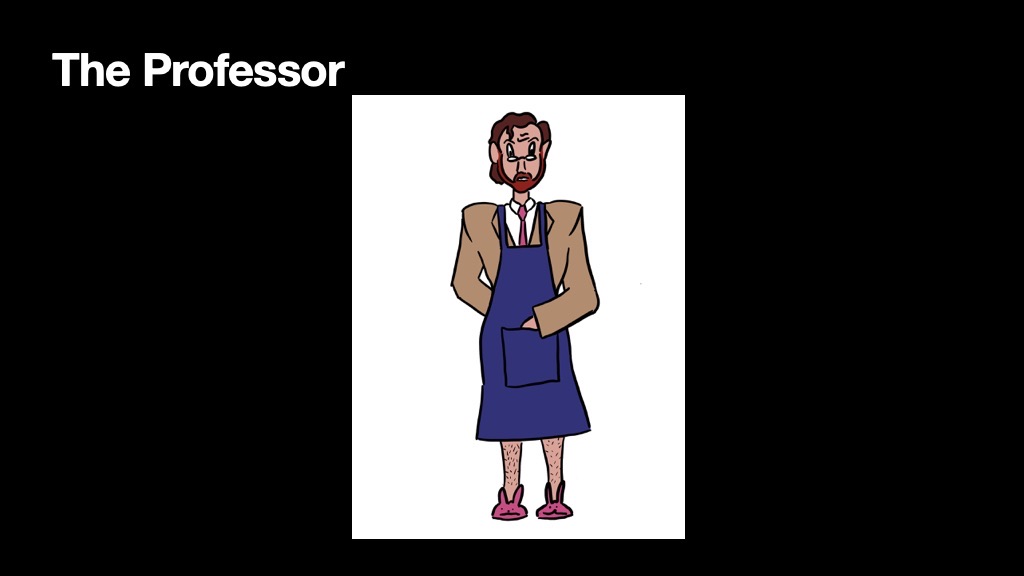
Lights up on Max, listening to music in her bedroom. As the song begins, she is interrupted by the sound of Squarking echoing up from a hole in the wall next to her bed. Frustrated, she takes off her headphones and crawls into the hole, scooting down a metal slide that leads to her father’s laboratory. The lab is a mess and Dogpoodle is running around destroying everything. Cartoon hijinks ensue, until they are interrupted by the arrival of Max’s father (the Professor). The professor is distraught, as Dogpoodle was supposed to be a surprise for Max’s birthday and now the surprise is ruined. Max does not like Dogpoodle and thinks that the gift is childish. The professor is convinced that if they had met in a less chaotic way, then they would like each other. The professor insists that he can fix everything by erasing their memories. He knows that he invented a memory erasing machine at some point but he cannot remember making it. After some searching he locates two helmets, one on Max and one on Dogpoodle. Unfortunately, this is not the memory erasing machine but is instead the mind-swapping machine!!!! Once their brains swap, Dogpoodle (in Max’s body) freaks out, breaks the machine, and goes running off down one of the slides. The professor is distraught again and in a desperate attempt to fix the mistake suggests that they use the Time Machine, which he has sworn never to use. The plan is to go back in time and replace Dogpoodle with Max (in Dogpoodle’s body). Then, when their past selves attempt to erase the memories, Max will be swapped into her past self’s body. When their past selves attempt to use the Time Machine, the professor will have swapped it so that the slide leading to the Time Machine is diverted to his garbage chute, which leads to what he calls garbage world. Max eventually agrees. They go down the slide to the Time Machine and come out into the garbage world. The professor says “well, the plan worked…” (the audience realizes that they have been following the story of the past selves who got tricked).
Garbage World
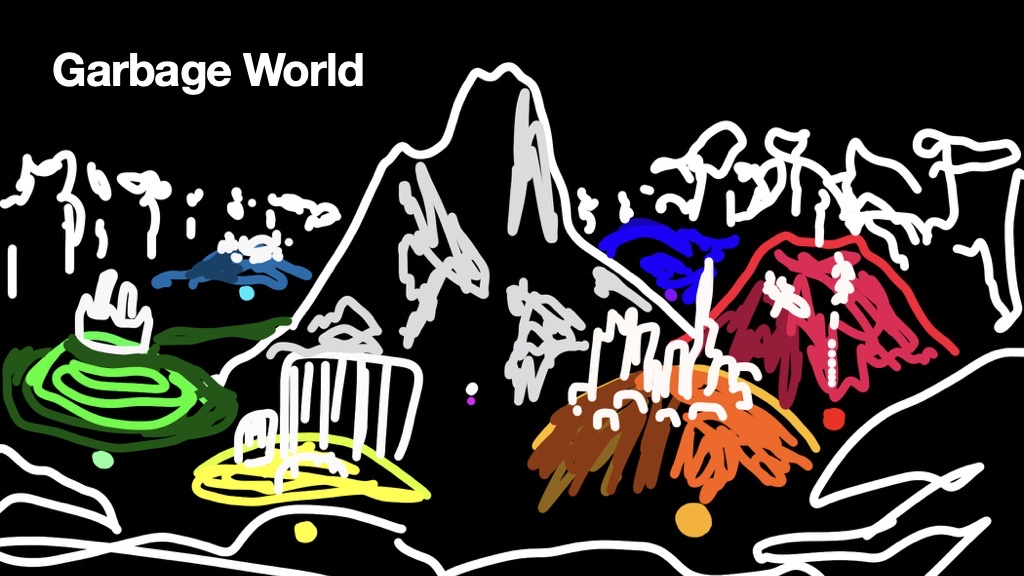
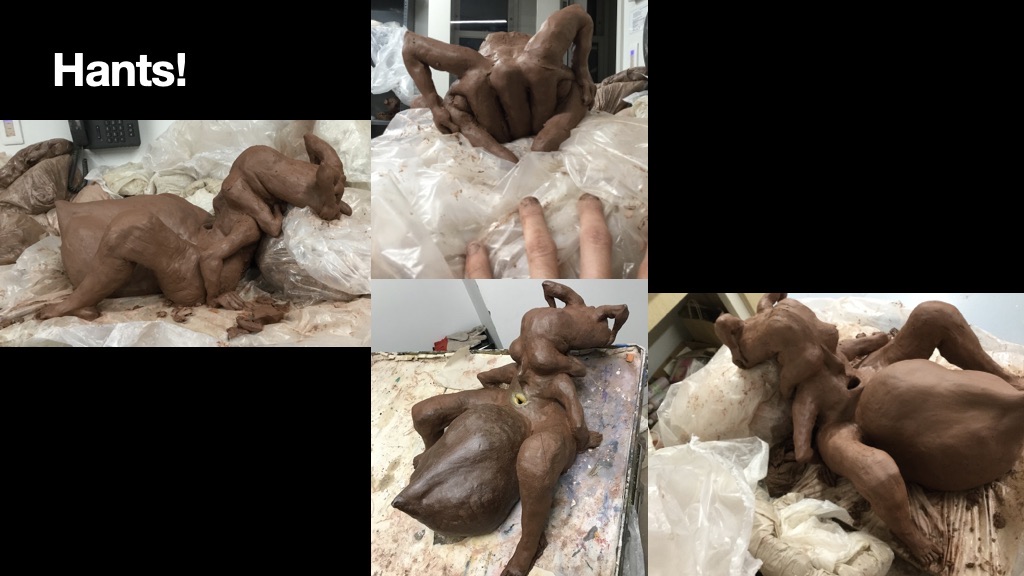
Garbage World revolves around one large white mountain surrounded by six different colored hills. Under the mountain is the white Time Machine and under each hill is a different color of Time Machine that changes your color when you use it. On top of each hill is a city that centers around one of the professor’s inventions. Upon arrival the professor is whisked off by the Hants, creatures that defend the time machines, collecting anything that comes out and keeping anyone from using them. Towards the end of the story it is revealed that the garbage world is actually just the future and that the professor has been throwing all his garbage and inventions into the future.
Plot Constraints 1 (Jump Lengths Short and Long)
How does the narrative affect our choice in mathematical axioms? From a narrative perspective, we don’t want to have time machines that can travel to any point in time because then at any moment any of the characters could wipe out all that had been done in the whole narrative. It would be very unlikely for time to make progress in the forward direction if anyone could go back as far as they liked. Narrative events like deaths would seem meaningless if you could always go back and undo them. Thus some simple restrictions on when you can travel are needed.
Short term time travel in the style of the Harry Potter time turner is very appealing because it does not have these narrative shortcomings, but it is also necessary to the plot to have at least one very long time jump (the jump that sends them thousands of years into the future with garbage world). The final type of jump that I am interested in creating is the medium jump (one that spans the length of time that Dogpoodle spends in the garbage world) but we will get to that jump later… For now I devised a simple system that give you both of the first two jump spans in a symmetrical and elegant way.
Any time that you touch the Time Machine to trigger time travel, the Time Machine will take you to one specific point in time that is not changeable and can be calculated by this function: If X is the length of time that the Time Machine exists in total, and you enter the Time Machine Y units of time after it came into existence, then the Time Machine will bring you to time X−Y.
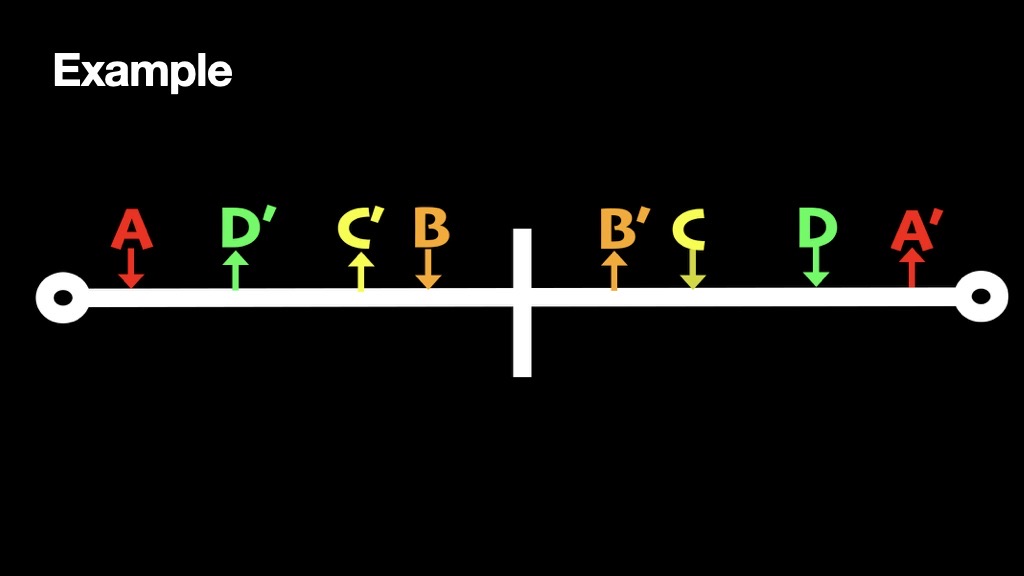
What does this mean in action? The Time Machine has a total duration and if you go in near the beginning then it will take you near the end, and if you go in near the end it will take you back to the beginning. The duration for the main time machine in the story is thousands of years and the professor starts out very near the beginning, so that is why the professor uses it like a garbage can, throwing things thousands of years into the future.
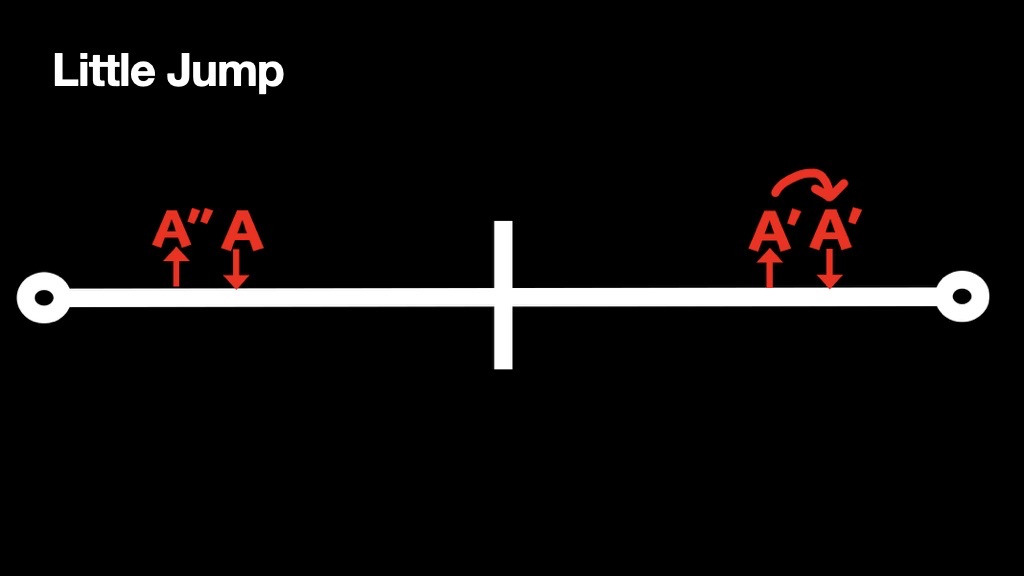
This system allows for short jumps in time as well! Imagine that the start of the time machine is 0, you are currently at time Y, and you want to go back in time Z minutes to time Y − Z. Using the time machine will take you to time X − Y. Wait Z minutes in the future and you will be at time (X−Y) + Z. Use the time machine again and you come out at time X − ((X − Y) + Z)) Which simplifies down to Y − Z. :)
Get it? No matter where you are in the duration, if you use the time machine, wait Z and then use it again you will come out z minutes earlier than you were. Clever minds may be thinking “WAIT!!!!!! How do we know that algebraic simplification works for time travel???” The true answer is that it doesn’t always, because the time that you return to may not be identical to the time you would have been brought to had the machine take you a straight shot by Z minutes. The main downside here is that if you wait the z minutes in the past you might do something there that changes the future that you are returning to, and if you wait in the future, a time machine defender might scoop you up and keep you from using it a second time. The problems are actually good ones to have. I want short time jumps to be highly risky to use and so that characters don’t overrely on them.
Still… you gotta admire the sexy simplicity of this axiom. You don’t need some big machine with dials and buttons. Just a smooth orb. Dogpoodle time travel is designed to feel natural rather than scientific. As you will see later, even the term “Machine” might be a misleading word.
If you are in the second half of the second half of the span, no non-duplicate has used the time machine since the middle.
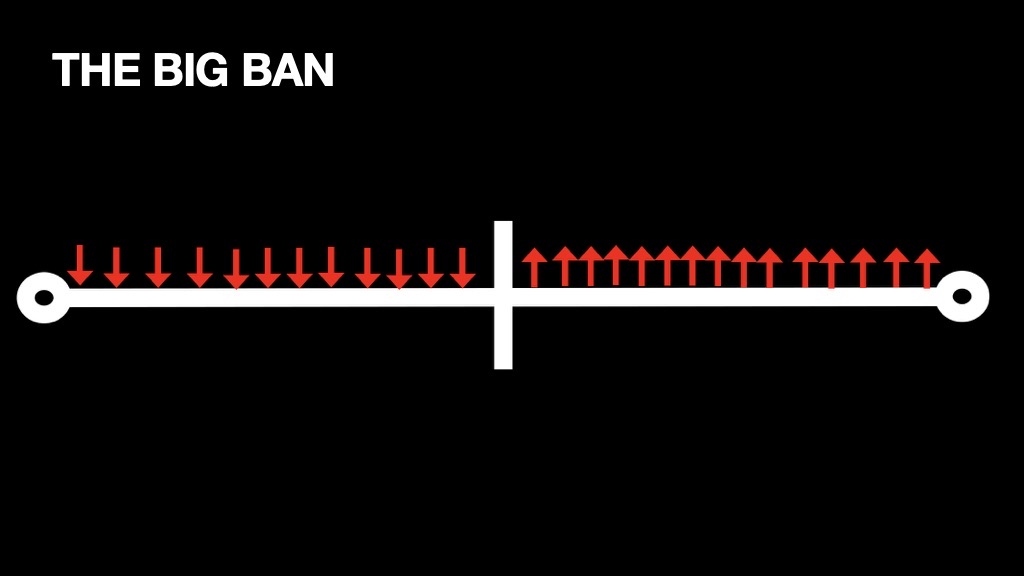
You still might experience some things that feel like time travel. For example you might think you see your “future self” come out of a time machine, but that “future self” will have just time traveled forwards from the past, because a short term backwards jump is made by combining a long term back jump and a long term forwards jump. So again, if you call the midpoint C, and you are at C+Y, then it has been Y time since anyone who isn’t a duplicate has touched the time machine. Put simply, if anyone uses the time machine after C, THE ENTIRE WORLD AS THEY KNOW IT IS UNWOUND, ERASED, DESTROYED, EGADS!!!!!
History of the time machine
Before the first C, nobody besides the professor knew that the orb was a time machine. Everybody thought that it was a vaporizer or the ultimate garbage can and they threw a ton of stuff into it. After C, any new garbage travels back to the past so a little before C people begin to figure out that it is a time machine and use it a lot. Time gets stuck in a loop near C for a while. Then people realize how it works and ban anyone from using it past C, setting up guards (The Hants) to catch anyone who might come out and keep them from going back in.
**** Importantly, the professor can still use the time machine back in the day. His lab is very remote and secret, so humanity would not find the machine without him. In versions when he is queued forward, he comes out far in the future where the time machine was never found and is able to go back without anyone stopping him. The professor knows that at the end of his life he has to let the world know its location to keep the stuff he threw into the future from coming back to mess with him… ***
Plot Constraints 2 (Organizing the Garbage)
There are six rainbow time machines that also change your size and color, and one White time machine that does not have those side effects.
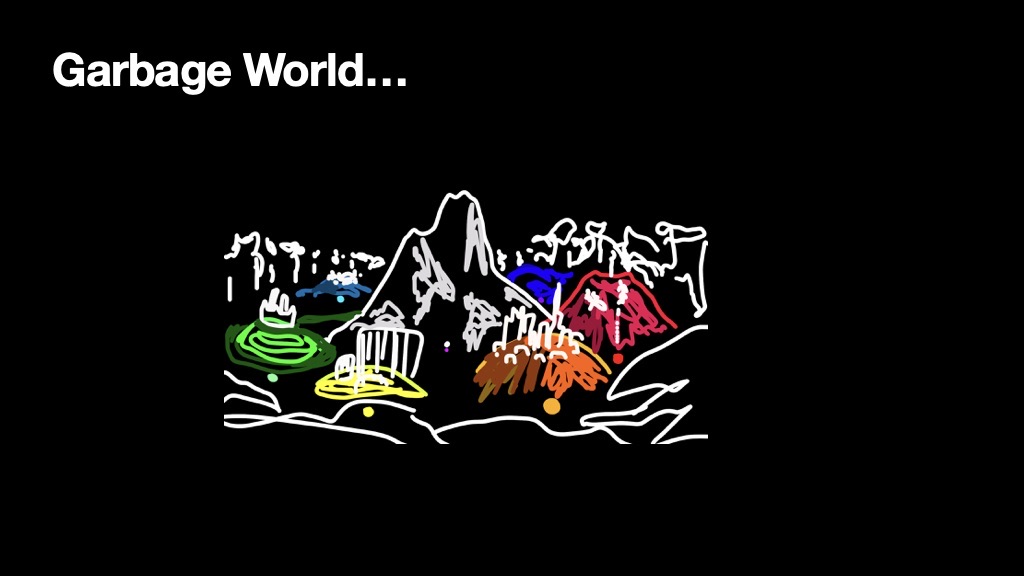
I first imagined the Garbage world would look like a rainbow pie. Six different-colored hills around one big white mountain. Under each of the hills is a time machine that is the color of the slice. Those time machines grow over time, so using them would change your color and size. Each of the hills was made up of the decayed refuse of all of the past time travelers. It was epic. When I came up with this image, my original idea was that each of the rainbow time machines was a prototype of the white time machine in the middle, and the white time machine was the only one that doesn’t change your size when you use it and has a much longer span, but I ended up scrapping that idea when I had the big breakthrough.
The material that comes out of the time machines is magical. Once it exists, dies, and breaks down into soil, by using that soil as clay, you can sculpt creatures that come to life when you fire them.
In the garbage world, there are all these rainbow clay creatures running around… Dogpoodle was actually sculpted from this clay.
The Big Breakthrough
In math, when you can simplify your axioms that is the sexy and cool thing to do. In my garbage system, I had 7 time machines, one for each color. I imagined that the white time in the future was the same one as the one in the past, so that when Max and the Professor come out in the garbage world, they start in the center of the white mountain.
Then I had this crazy idea… The time machines already excel at making clones, so what if the rainbow time machines were somehow all clones of one time machine that changed color. They were made by putting that time machine into the white one. That way the two time machines that I needed at the beginning (one for time travel and one for garbage world) could be the only two in the whole story.
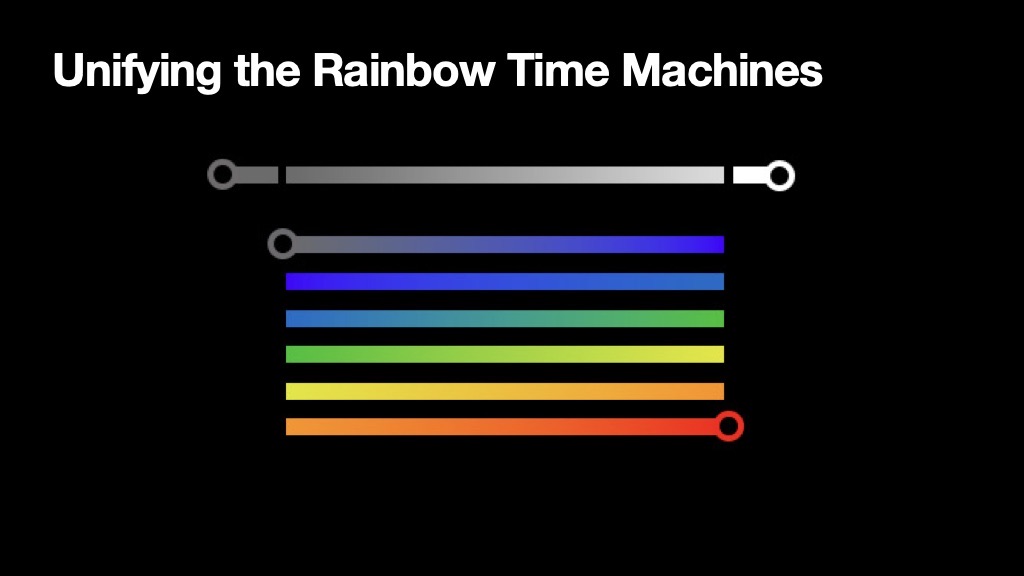
The “rainbow” time machine has a much longer duration, that is a little under 6 times longer than the white time machine. (Gross and random I know but we will improve on this axiom later.) Over time, the rainbow time machine grows slowly and changes color about once per span of white one, so if you go in near the beginning when it is small and purple, you come enormous near the end when it is large and red.
Near the end of the white one’s span, the purple gets put into the white one, and brought way back in time making two machines. Another white span passes, the one that got brought back turns blue, and they both get put into the white one. This process gets repeated 6 times to make the world into the state it is today.
GROOSSSSSS, (very contrived), but promising.
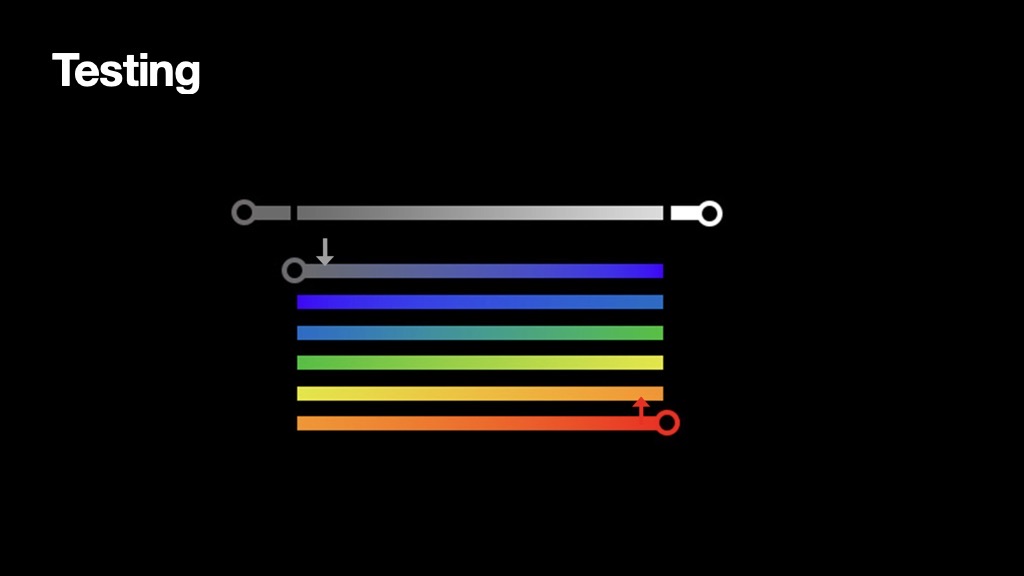
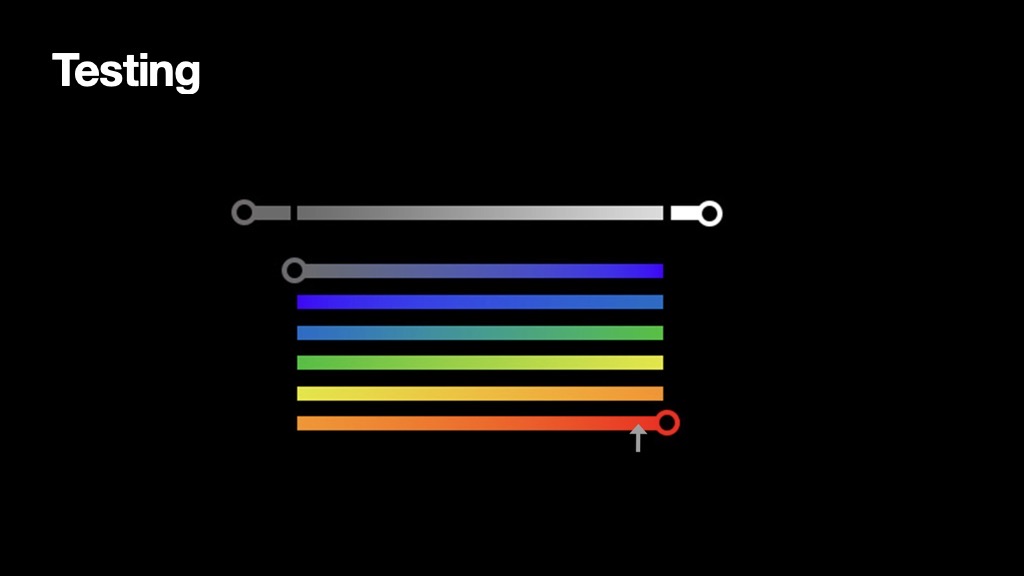
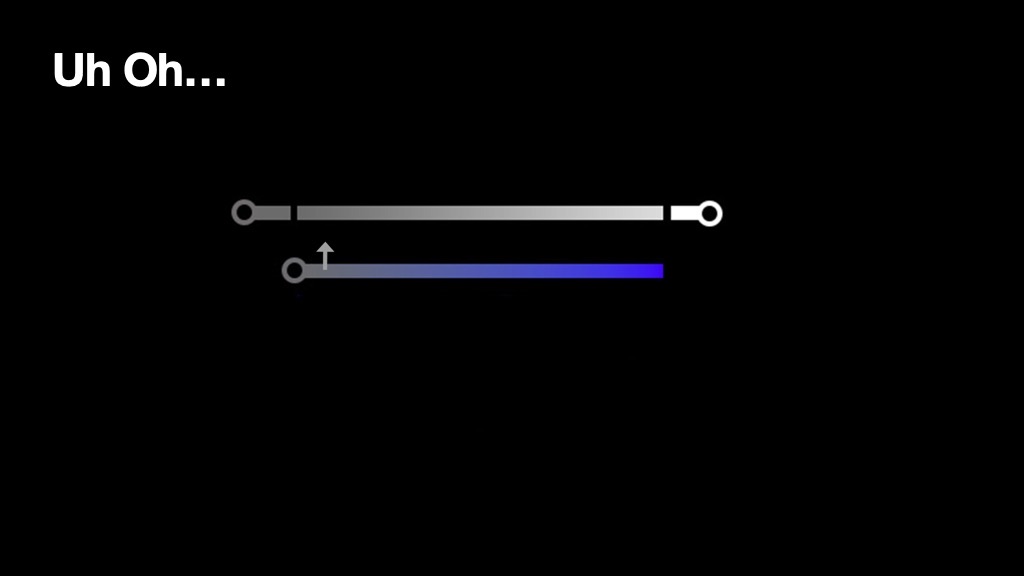
The obvious problem: say that you get into the red time machine. Sure you will come out of the purple one at X − Y, but you will come out in a different world in which the red time machine does not exist yet. If you go into the purple one, you will come out WAAAAAAAYY (like 6 white spans) in the future, because this version of the purple one is different from the version that the red one used to be. The big breakthrough was that this purple might go through the same journey that the original purple one did. The whole system might work, you just need a shit ton, (bajillions and bajillions), of cycles.
Loops and Cycles
Here is the crazy idea: What would happen if the rainbow machine was in some sort of orbital pattern with the white machine that caused it to travel inside the white’s radius towards the end of the white’s span. The rainbow machine would be brought back all the way to the beginning and now there would be two rainbow ones moving forward, but each would have existed for a different amount of time. Those change color as they orbit toward the white radius and are sent back. This pattern repeats itself until there are six different colors of time machine, at which point the rainbow one’s span ends and the red machine disappears. The remaining five are brought back in time, joining the original purple one there and starting the process over.
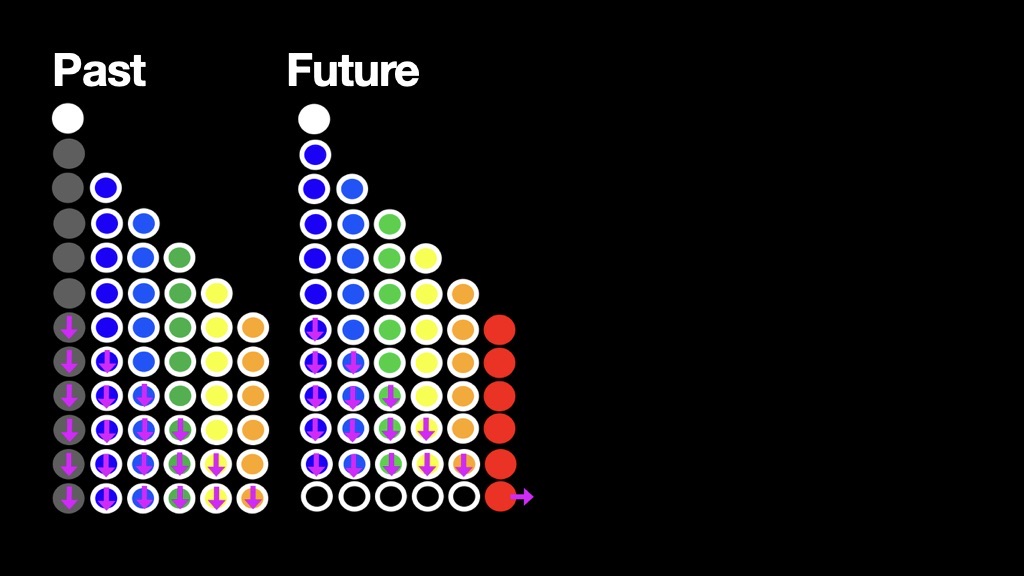
Because of Axiom 3 you might think this would only loop one time, but so long as the time machines get new inputs during the loop, they will not be identical to the previous iteration of time machines. This loop will continue until all the time travel in the rainbow machine has been fully resolved at which point they would all disappear. That could take trillions of loops… Our story takes place in the final loop, when everybody has already used the time machines for everything. If you cycle back a loop you end up in a reality that is almost identical to the cycle that you came from, making it feel almost like regular time travel.
By this method we have “bootstrapped” a system that feels almost identical to if they were all separate time machines that led to each other. This gives us the mathematical simplicity of having fewer ad hoc math axioms (two time machines with unique rules are simpler than 7) while preserving the narrative feeling that we desired.
THIS NEW SYSTEM IS REALLY CONFUSING so let’s unpack how it would work in a simple situation.
Imagine that nobody used the rainbow time machine at all. Then you would have the 6 basic loops to start up the 6 rainbow time machines, and at the end of the 6th cycle it would be identical to the previous one and all the rainbow machines would just be erased by the white one and time would keep moving forward.
Now imagine that during the 6th cycle someone used the purple time machine. That person would be queued up going forward, so the purple machine would be different from the purple machine from the previous loop that did not have anyone queued up in it. During the 7th loop everything would happen the same way that it had in the 6th loop, so another version of yourself would get in the purple queueing forward. This time when it cycled, the purple time machine would be identical to the one from the last loop because they both would have a copy of you queued up, but the blue one would now be different because it would have you queued up in it. This cycle would continue until the 12th loop when the first you to queue up would come out of the red machine and the red machine would conclude its span and vanish. Now the other five machines would go to cycle and all of them would have a version of you queued up to come out in future cycles, identical to the 5 machines that had gone through the last cycle and the five machines would all be erased by the white one and time would continue.
Here is the challenge: the first five loops would be remarkably different from each other because each would have a different number of time machines. After five loops they would start to become more similar, but the different travelers queued up would cause very different events to happen in each loop. My belief is that over time each iteration would become more similar, approaching the queue list of travelers that you would get if all six time machines had always existed. It is theoretically possible for this loop to be infinite and not converge, but all I care about for the storytelling is that there are cases when it does converge as shown by the only-one-traveler case.
(DON’T STRESS THIS ONE TOO HARD!!! VERY LOW LEVEL STUFF LIKE BINARY FAR FROM THE PLOT.) So let’s call the midpoint of the rainbow machine D. Note that the entire existence of the purple version of the time machine is pre D, so to all those observing, it would seem like a garbage can until the 6th loop. In fact, the first thing to come out of the rainbow time machine would come out of the Yellow one, at a point in time near the beginning of the white span. That thing would be coming from WAAAY in the future and would have gone into the green time machine on the previous cycle. Once the fourth cycle starts you could theoretically start using the yellow one for short term time travel, but if you went into it before C, you would come out post C and get picked up by the Hants. The second time you went into yellow you would just disappear due to Axiom 3, because nothing that your first version did in the previous cycle could impact the second you’s decision to use the yellow time machine. The existence of the Hants means that the yellow time machine still feels like a garbage can to anyone who uses it before C, and almost nobody uses it after C unless they can outsmart the Hants.
Basically, the end result is that by the 7th loop, the rainbow time machines all revolve around the white time machine’s version of C. They have the same ban on their use after C as the white one does. The beautiful thing about this is now, nothing that comes out of the rainbow time machine past loop 7 ever affects anything that goes into the rainbow time machine, because everything that goes in comes out past C and cannot go back in or influence anything to go in. This means that cycle 13 should be identical to cycle 12 and the whole thing should be clear! Our story can then just take place in cycle 13 unless people outsmart the Hants.
(If only it were that simple ;)
Plot Constraint 3 (Darkpoodle and Medium Jumps)
I wanted the garbage world to be uniquely separate from the rest of the time travel system… I dreamed of being able to use the time machines there without the consequences of you using them affecting the rest of the system. Luckily, while designing the loops I discovered skewing…
Skewing
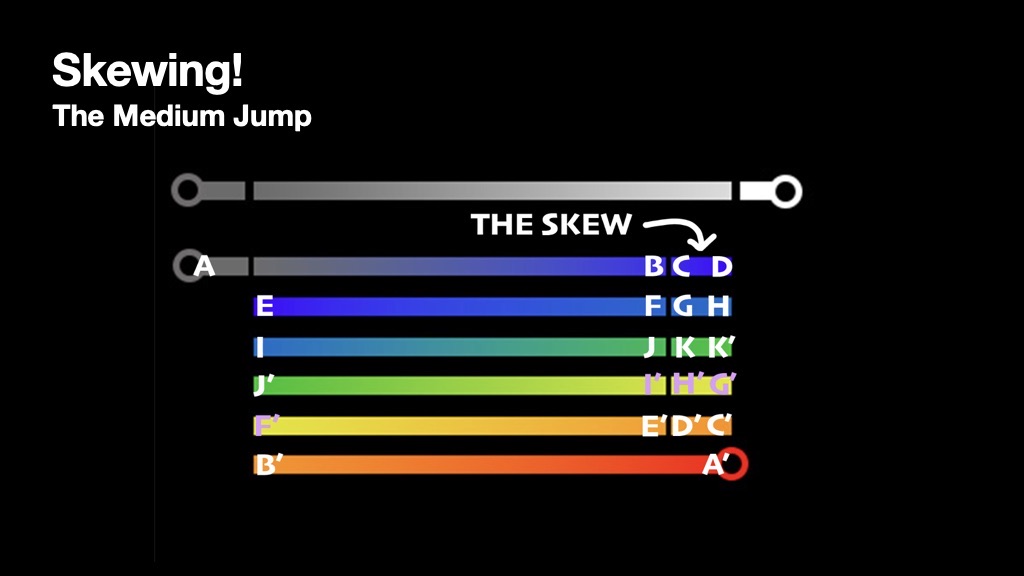
What skewing does is it breaks up the rainbow time machine into two parts that work like two different spans…
The basic idea behind skewing is:
If the white machine and the rainbow machine begin at the same time 0, and the purple version of the machine goes into the white one at time Y, then it will come out as the blue machine at point X − Y.
Let’s define a new length, Z, equal to X − Y.
Purple will exist for Y years, but each other color will come into existence as time Z and only exist for Y − Z years before it gets looped. Let’s define a new variable W that is equal to how long before time Y the red time machine ends its span.
The span of the rainbow time machine is Y + 5(Y − Z) − W.
For the purposes of simplicity, let’s start with the scenario where w = 0.
If you go in the purple machine at time 0.1 then you come out the red machine at time Y − 0.1.
If you go in the purple machine at time Z, you come out at the point in the span that is [Y + 5(Y − Z) − W] − Z. In other words you would come out of the red time Machine at Y−Z.
If you go in the purple machine at time Y−Z, you come out at the point in the rainbow one’s span that [Y + 5(Y − Z) − W] − [Y−Z]… which = Y + 4(Y−Z) Remember, the whole length of the red section is Y−Z so you are a full length less than the rainbow span. In other words, if you go purple at the start of the skew, you will come out of orange at the end of the skew.
When you draw it out, you see that past Z, the rainbow machines all function like time machines that start at Z and have a span the length of (Y − Z) − (Z + W).
Then, at point Y − (Z + W) the purple-orange ones start to function like time machines that have a span length (Z+W). (or when w = 0, just Z).
What I realized is that I wanted the whole plot in the garbage world to start at Y−Z and end at point Y when they cycled. That way any of the rainbow time machines that got used would spit you out in the span of the skew, and thus the time travel would not affect any of the things that happened before Y−Z, and you could use the time machine without risk of the butterfly effect altering the world that you would arrive in.
This is crucial to the plot because early on the Dogpoodle actually uses the purple time machine in the skew. This creates a clone called Darkpoodle who is central to the narrative.
The Ideal Narrative Skew…
So I wanted the story of Dogpoodle to take place over the course of a year in the garbage world. I had hoped that there was a way to time Dogpoodle’s arrival to sync up with the skew so that when Dogpoodle used the purple machine to become Darkpoodle, she would first come out of the red machine near the end of the plot and meet the queen of the Hants.
I had also hoped to have Dogpoodle and the professor enter the white machine in the pilot, before the rainbow machine duplicates arrived. If that were true, under the Z=0 Skew, they would come out after all the rainbow machines had been cleared by the white machine, which would be too late.
On a 60 hour plane trip I finally figured out a solution!
The Crash
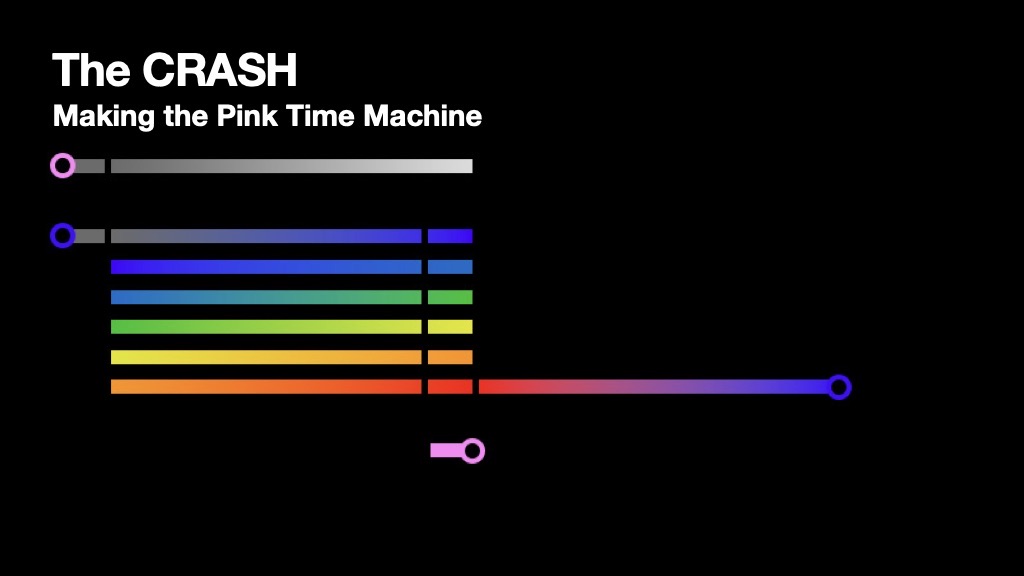
Rather than having the white machine loop the rainbow machine, I began to experiment with the idea that the white machine and the purple machine might CRASH into each other and simultaneously activate. This would cause the white time machine to scan its radius and bring back all five of the rainbow time machines like before, but it would also cause the purple one to scan. The purple radius is much smaller than the white because the rainbow machine grows over time, so the only thing in the purple’s radius when they crash is the white time machine.
The crash happens at time Y, so that would mean that a clone white time machine would be queued up to come out of the rainbow time machine along its span at (Y + 5(Y − Z) − W) − Y. This would mean that if W = 0, it would come out of the orange machine at exactly the beginning of the skew!!! Because the rainbow machine changes the color of anything that goes through it, the white machine would come out a light orange… Not perfect, but if I could somehow get it to come out of the red machine, then it would come out PINK the same color as Dogpoodle!!!!
So is this possible? YES! I had always assumed that W had to be positive, but if you make W = −(Y−2Z) then you get (Y + 5(Y − Z) − [−(y−2Z)]) − (Y − Z) =
6y − 5z + y − 2z − y + z = 6y − 6z = right at the start of the red skew!
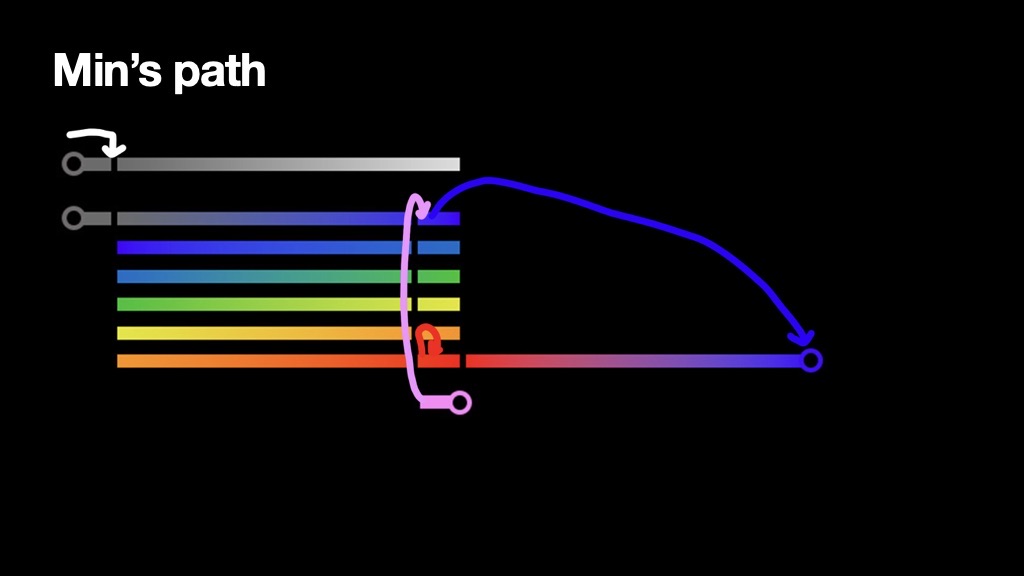
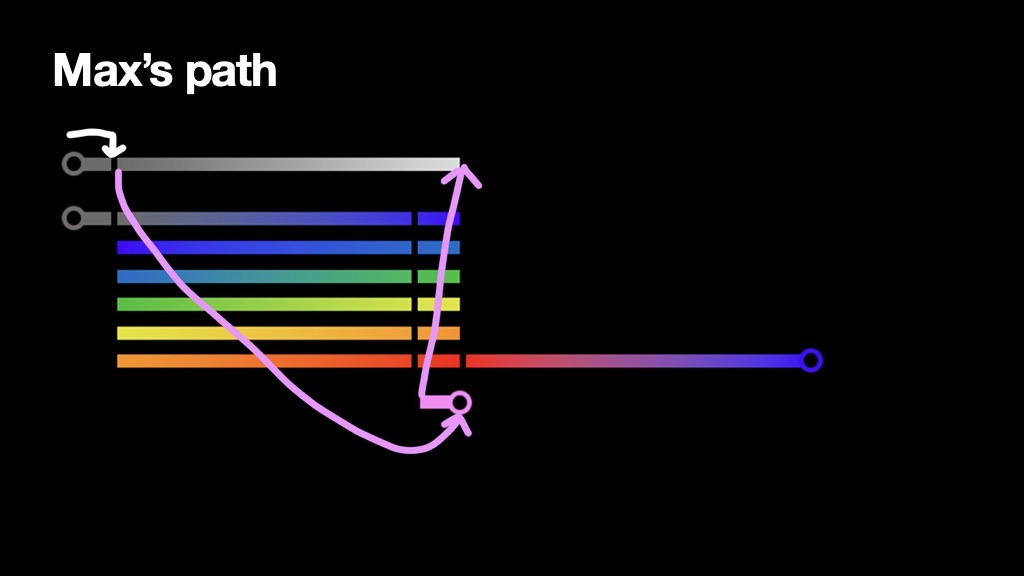
If Dogpoodle entered the white machine right before the rainbow ones appeared, then Dogpoodle and the professor would be queued up to exit the pink time machine right after it popped out of the red at the beginning of the skew! This all works because Dogpoodle is pink so no change. The professor will also become pink now… Oh well. :) So cute!
You may be wondering about why the red machine would not also loop, let’s just say that the white machine only fits 5 of them into its radius. Something about orbits… idk. ;)
The Paradox Constraint
Okay so remember when I said “No-Paradox Time Travel”…. I lied. The Dogpoodle time travel system has one paradox and it is a famous one:
Which came first: the chicken or the egg?
Huh? You might be wondering… Remember how I said the word “Machine” might not be totally accurate… These beautiful time-altering spheres are no machines. They are EGGS! What kind of egg?
DOGPOODLE EGGS!!!!
Dogpoodles have a very complicated reproductive system that involves a lot of time travel (more in this later).
Laying Themselves
So the paradox I am hoping to add is that Dogpoodles lay their own eggs! (Such a strange creature.)
They come into existence the same time that dogpoodles do, and all dogpoodles live for the span of time that we have been referring to as X. (The length of the span of the white time machine.) At the end of their lives they lay their own eggs in reverse; the egg goes into the adult Dogpoodle and they disappear together.
By the end of the narrative skew, both Dogpoodle and Darkpoodle have been alive for 2Z years. That means they both have Y − Z years left to live. The conflict between them ends with Dogpoodle and the professor entering the white radius as they crash and return home. (So dogpoodle) Y−Z years later, dogpoodle lays the pink egg at the end of its span. Darkpoodle stays in the future to be with her love, and Y−Z years later she lays the Rainbow egg at the end of its span.
Reverse Engineering (The least mathematically sound bit)
So this last part got a little screwed up in the recent patch, but the basic idea is the explanation of the length of the skew… My idea is that the professor made a Dogpoodle as a present for Max’s birthday, but was a little late so had to wait a whole year before giving it to her. When Dogpoodle came into existence, so did the white egg. Max found Dogpoodle the day before her birthday. The plot began, and they and used the time machine in a way that created a dogpoodle copy, when the copy was created, time unwound all the way to the beginning of the span and created a second egg, so that it would be there when the copy was introduced, but this time when Dogpoodle entered the time machine to go forward, both of the eggs were drawn towards the location where dogpoodle would come out, and they crashed into each other at the exact moment that dogpoodle was due to come out, this created the whole 6 loops and caused dogpoodle to come out of the pink one instead. The rainbow needed to be laid at the end of darkpoodle’s life, so its span was extended causing this weird thing with the colors like when light moves through glass. Idk if this makes any sense but I kind of like this explanation…
GIANT RAINBOW DOGPOODLE
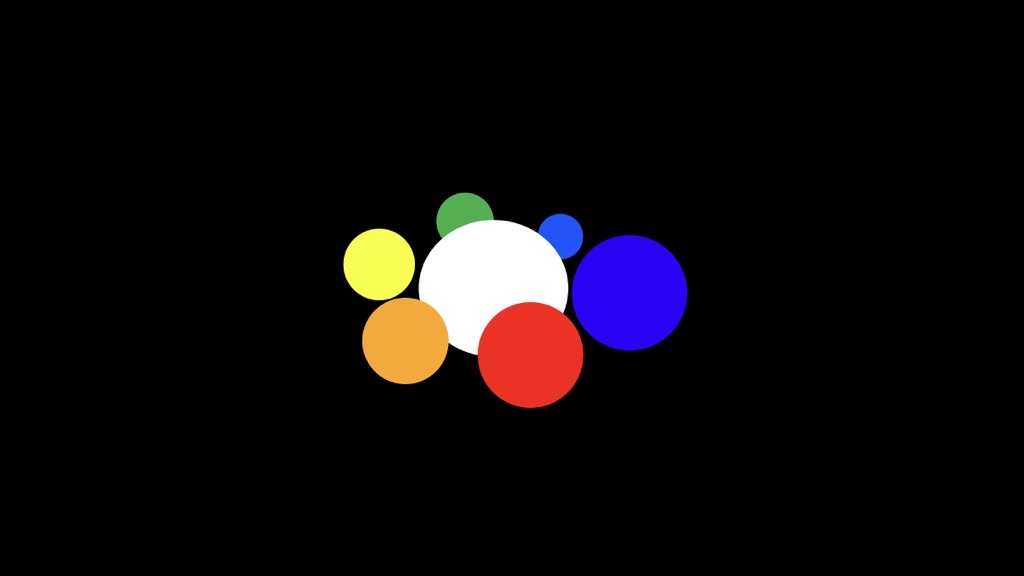
So why have this complicated reproductive system? Well, dogpoodles are half-mammal, half-bird, so their eggs also serve the function of an egg and a sperm (hence the little white and large red). As they go through this crazy looping process they created the mountain and six hills of magic clay that the Hants sculpt into the shape of an ENORMOUS DOGPOODLE. Dogpoodles have 7 puffs of fur (head, tail, 4 feet, and the big puff in the center) so each hill is a puff of fur! One day, when an asteroid comes it will heat up the clay and that giant rainbow dogpoodle will come to life and fly away into outer space. :)
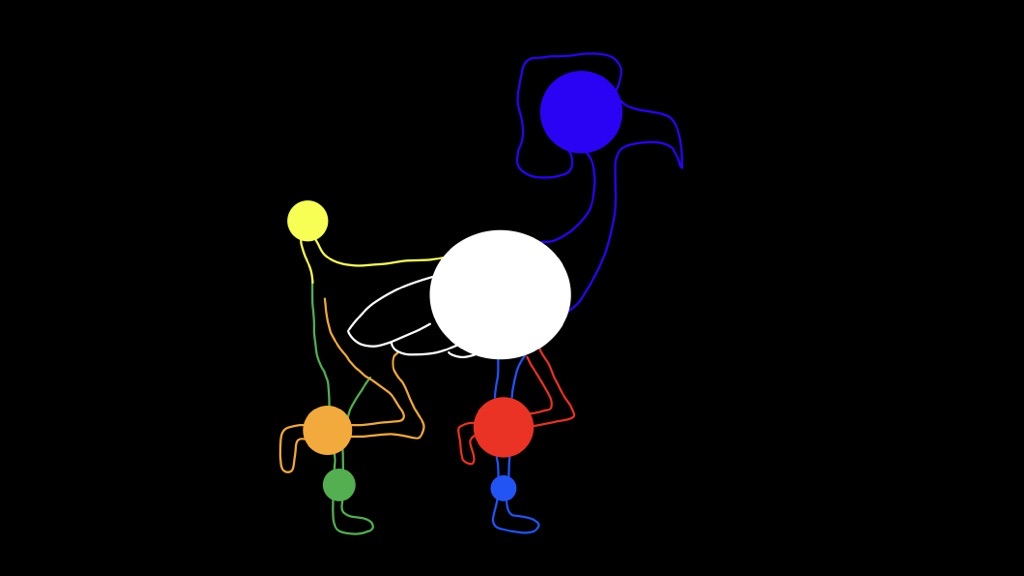
DOGPOODLELOOPEDGODDOGPOODLELOOPEDGODDOGPOODLE
LOOPEDGODDOGPOODLELOOPEDGODDOGPOODLELOOPEDGOD
QED